

How to Read Aloud Over Video Call: A Warm, Practical Guide for Far-Away Grandparents and Family
Quick Answer
To read aloud over video call, give both households the same print book, agree on a page or chapter, and treat the call as a conversation with a story in the middle, not a performance. Short, regular sessions work better than one long one.
The aim is the same as in person: connection. A calm voice, a steady schedule and a few questions for the child are far more important than a perfect picture or a perfect reading.
Key Facts
- The American Academy of Pediatrics’ September 2024 policy statement recommends shared reading from birth through at least kindergarten, and says print books are preferred for it.
- The same statement says digital books “do not foster equivalent parent-child interactions” and advises that when screens or audiobooks are used, caregivers should include reciprocal interaction around them.
- The AAP describes shared reading as a way to build loving, nurturing relationships.
- Advent 2026 begins on Sunday, November 29, and Christmas Eve falls on Thursday, December 24, so a call-based reading can run for about four weeks.
- The AAP statement does not address video calls specifically, so the advice in this guide applies its principles by analogy, as a recommendation.
Why read aloud over video call at all?
If you are a grandparent, aunt, uncle or godparent who lives far from the children you love, you probably know the particular ache of holidays at a distance. Gifts can be shipped. Cards can be mailed. But sitting beside a child while a story unfolds is harder to send.
A video call will not replace that closeness, but it can carry a surprising amount of it. A shared story gives the call a shape and a purpose, which is often what is missing when a child is shy on screen and an adult is not sure what to say. Instead of asking “What did you do at school?” and waiting through a silence, you can open a book and begin.
There is also a practical benefit for the parents. A regular reading call gives them a pocket of time while someone else holds the child’s attention, and it gives the child something to look forward to that is not a screen game.
What the AAP says, and what it does not
It helps to be precise about the research here. The AAP’s 2024 policy statement strongly supports shared reading starting at birth and continuing at least through kindergarten. It says that turning the pages of a high-quality print book with colorful pictures and rich language is considered best. It also says that digital books do not foster equivalent parent-child interaction, and that if screens or audiobooks are used, parents should include reciprocal interaction around them.
The statement does not talk about video calls. So we should not claim the AAP endorses reading over video. What we can say is that its guidance points in a consistent direction: keep the book physical if you can, and keep the back-and-forth between reader and child alive. That is a good compass for a call.
In practice, this means two things. First, aim for each household to have its own print copy, so the child is turning real pages while you read. Second, treat the call as a two-way conversation. Pause often, ask questions and let the child answer. A story told at a child is passive. A story told with a child is exactly what the AAP describes as responsive reading.
Set up before the first call
A little preparation prevents most of the frustration. Here is a checklist.
- Get the same book to both places. Order or mail a copy early enough to arrive before your first session. If that is not possible, a shared copy on one side with a few photographed pages for the other is better than nothing.
- Agree on page numbers. Different printings may paginate differently, so agree on a landmark, such as the chapter title, not just a page number.
- Pick a regular time. A set time, such as Sunday afternoons or Wednesday before dinner, becomes a ritual faster than a flexible one.
- Test the setup. Check the camera, the sound and the lighting. A lamp in front of you, not behind, makes your face easy to see.
- Prop the device. Propping the device on a stack of books lets everyone keep their hands free for pages.
- Tell the parent your plan. A short message such as “We’ll read one chapter, about fifteen minutes” helps them plan their evening.
If you are the one mailing the book, a handwritten note inside the cover makes it feel like a gift, not a homework assignment.
How to run the call
Once you are connected, a simple structure keeps the session warm and focused.
Open with a greeting and a recap. Ask the child to tell you what happened last time. This builds memory, and it gives a hesitant child an easy way in.
Read slowly. Video can add a slight lag, and a slower pace makes it easier for everyone to follow. Leave small pauses at the end of sentences.
Show the page when you can. If the book is illustrated, tilt it toward the camera now and then, or ask the child to hold up their own copy at the same picture.
Ask one question per scene. “What do you think the nutcracker is thinking?” or “What would you do?” One question is enough. Wait for an answer.
Let the child turn pages. If they have their own copy, let them be the one who turns the page when you say “turn the page.” It gives them a job.
End on a ritual line. Choose a closing phrase and use it every time. By the third call, children often say it with you.
Keeping it short, and keeping it going
Ten to twenty minutes is plenty for most children, and many do better with less. A short call that ends while the child still wants more is far better than a long one that ends in restlessness.
If you miss a session, do not worry. Send a quick message, such as “We’ll pick up next week,” and move on. The tradition is the pattern, not any single call.
If the child’s attention drifts, try changing the activity, not the plan. Ask them to draw a character and show it to the camera, or invite them to read a sentence aloud to you. Giving children the role of reader often brings them back.
Reading a classic over a call: the Nutcracker example
A classic like Hoffmann’s Nutcracker and Mouse King suits a long-distance routine. The story has fourteen chapters, and chapters seven through nine form the “Tale of the Hard Nut,” which Godfather Drosselmeier tells over three nights. You could echo that on your call by reading those chapters on three consecutive sessions.
Two cautions. First, Hoffmann’s original is darker than the ballet, with a seven-headed Mouse King, a night battle and a heroine who is hurt and not believed. When you cannot be in the room with a child, it is wise to check with the parents first about what feels right. Second, older language can be tricky to read aloud on a call, where a stumble can feel exposed. A short note from the parents, or an annotated edition, can help you avoid reading cold.
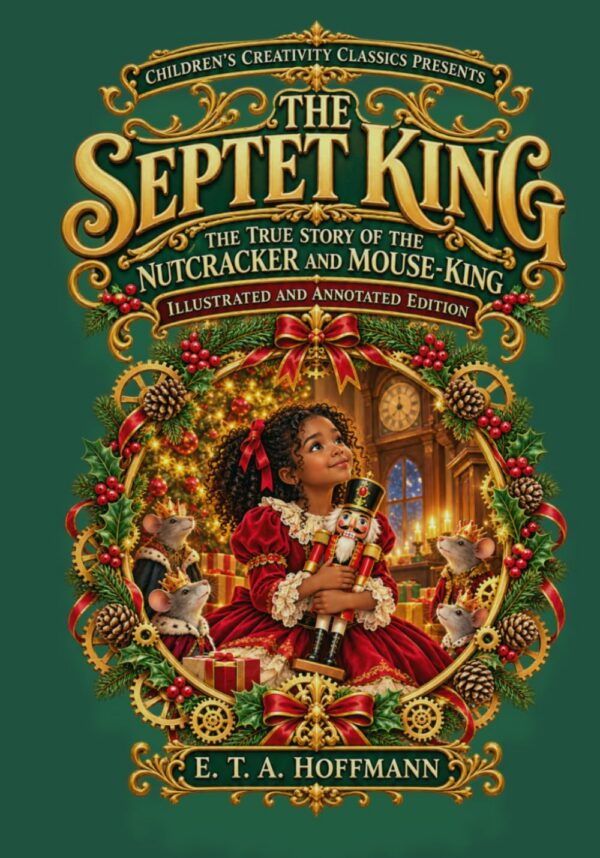
The Uply Media Publishing page lists The Septet King, an illustrated and annotated edition, at $22.98, reduced from $27.98, as of October 22, 2026. The page does not say how many pages it has, who illustrated it or what the notes cover, so check the sample pages before buying two copies for two households. If cost is a concern, a free older translation, available on Wikisource, lets you try the story first.
Making read aloud over video call a tradition that lasts
When you read aloud over video call, you are not trying to recreate the living room. You are building something new that belongs to the two of you: a time, a book and a way of saying goodnight across the distance. Children tend to remember the feeling of being the center of someone’s attention.
If you start this season, you will have a pattern by Christmas. If you keep it going afterward, you will have a tradition by next year. And if a call goes sideways, with a frozen screen, a wandering child or a stumbled sentence, you have permission to laugh, wave goodbye and try again next week.
A book for two households
If you would like to look at an illustrated, annotated Nutcracker and Mouse-King edition for your reading calls, see The Septet King on Uply Media Publishing.
Frequently Asked Questions
Does reading over video call count as shared reading?
The AAP’s statement does not address video calls. Its guidance on print books and reciprocal interaction suggests keeping a physical book and a real back-and-forth, which a good call can provide.
How long should a reading call be?
Ten to twenty minutes suits many children. End while they still want more.
What if my grandchild is shy on camera?
Start with a recap question and a shared book. Having something to look at together takes the pressure off eye contact.
Do we both need the same book?
It helps a great deal. If a second copy is not possible, photographing a few pages in advance is a workable second choice.
Can I read a scary classic over a call?
You can, but check with the parents first, since you will not be in the room. Preview heavier chapters and consider reading them earlier in the day.
What if the connection freezes mid-story?
Wait a moment, then pick up from the last sentence you remember. Keep a bookmark and a sense of humor.