

Intentional journaling is one of the most accessible tools for anxiety relief available to you right now — no special training required, no perfect conditions needed. It works by giving your swirling, anxious thoughts a place to land outside your head, where you can actually look at them, name them, and gently loosen their grip. This article is for anyone who has felt overwhelmed by worry and wondered whether putting pen to paper could genuinely help. It can — and this is how to start.
Understanding Anxiety and Why Intentional Journaling Helps
Anxiety has a way of making thoughts feel urgent and infinite at the same time. Your mind loops, catastrophizes, and rushes ahead to worst-case scenarios before you’ve even had breakfast. What intentional journaling does — as opposed to random venting — is interrupt that loop with structure and self-compassion.
Research consistently supports writing as a tool for emotional regulation. When you write about anxious feelings with curiosity rather than judgment, the brain’s threat-response begins to soften. You’re not solving the problem so much as witnessing yourself in the middle of it — and that witness is kinder than the inner critic running the anxiety loop.
Operators aligning intentional journaling with anxiety relief should document power, conduit, and permitting gaps before procurement.
Authoritative background on connectivity and deployment standards is available from FCC wireless infrastructure guidance.
When intentional journaling is the decision frame, journaling prompts milestones need to run in parallel—not in sequence.
The word “intentional” matters here. It means you come to the page with a purpose: to explore, to release, to understand — not just to list worries. That small shift in orientation changes everything about what you write and how you feel afterward.
How Do You Create a Safe Space for Journaling?
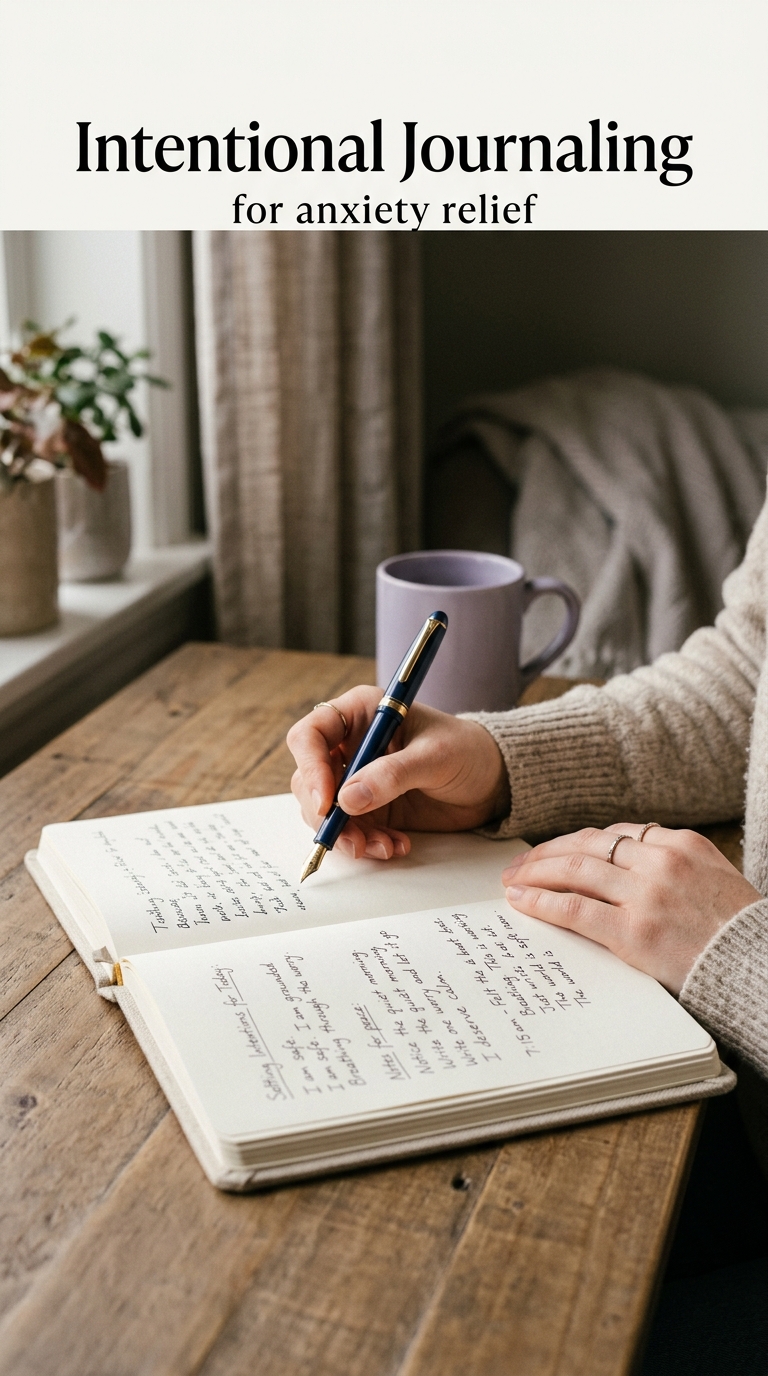
Your journaling environment doesn’t have to be elaborate, but it does need to feel like yours. A safe space for mindful writing is less about the physical setting and more about a felt sense of privacy and permission.
Notice what conditions help you feel settled. Some people need quiet; others find soft background music helpful. A window nook with natural light, a corner of a bedroom, even a parked car — the location matters less than the signal it sends to your nervous system: this time is for me.
A few small choices can anchor that feeling:
- Use a dedicated journal — one that feels separate from work notes or to-do lists.
- Try writing by hand rather than typing; the slower pace invites reflection.
- Start with just five minutes. Removing the pressure of a long session makes it easier to actually begin.
- Keep your journal somewhere visible but private — a place you associate with calm rather than obligation.
If you’re looking for a beautifully designed journal to anchor your practice, browse the Big Book Journals collection for thoughtfully crafted options that feel intentional from the first page.
Journaling Prompts for Anxiety Relief That Actually Work
The right journaling prompts don’t demand answers — they open doors. When anxiety is high, broad prompts like “write about your feelings” can feel paralyzing. More specific, grounded prompts give your mind something concrete to step toward.
Try these when anxiety feels loud:
- Name it to tame it: “What am I actually afraid of right now? What’s the specific fear underneath this feeling?”
- Ground the body first: “What do I notice in my body right now — tension, tightness, restlessness? Where exactly does it sit?”
- Find the facts: “What do I know for certain about this situation? What am I assuming?”
- Invite the compassionate voice: “If my closest friend were feeling exactly this way, what would I say to them?”
- Shift the frame gently: “What’s one small thing that is okay right now, even in the middle of this?”
These prompts aren’t about forcing positivity. They’re about creating a little breathing room inside the anxiety — a moment of perspective that the looping mind can’t generate on its own.
For more reflection tools and writing ideas, explore the Journaling and Mindset articles on this site.
What Do Healthy Journaling Rituals Look Like?
A ritual is different from a habit in one important way: it carries meaning. Journaling rituals for emotional wellness don’t just happen at a regular time — they feel like a small ceremony of self-care. And that quality of intentionality is precisely what makes them effective for anxiety relief over the long term.
You don’t need to journal every single day. Consistency matters more than frequency. Three times a week done with genuine presence outweighs daily journaling done on autopilot.
Some simple ritual anchors worth trying:
- Morning pages variation: Write three to five sentences — not stream-of-consciousness, but a deliberate check-in. “How am I arriving at today?”
- Evening wind-down: Before sleep, name one thing that felt heavy today and one thing that felt light. This gentle practice supports the mindset shifts that happen during rest.
- Threshold moments: Journal after transitions — after a hard conversation, before an anxiety-provoking event, or when you feel yourself starting to spiral. The page becomes a decompression space.
The ritual quality comes from showing up with attention, not from getting it perfect. Some entries will be messy. Some will feel flat. That’s part of the practice, not a failure of it.
Pros and Cons of Intentional Journaling for Anxiety
What works well
- Interrupts anxious thought loops with structured reflection
- Builds self-awareness gradually, without requiring therapy access
- Creates a private record of emotional patterns over time
- Flexible — works morning, evening, or in crisis moments
- Supports gentle mindset shifts without forcing toxic positivity
What to watch for
- Can become rumination if prompts are too open-ended or the session runs too long
- Not a substitute for professional mental health support in severe anxiety
- Requires some initial activation energy — starting is often the hardest part
- Without intention, journaling can reinforce worry rather than process it
Who Is This Practice Really For?
Intentional journaling for anxiety relief is for anyone who feels like their internal world moves faster than they can track — people who overthink, who carry worry quietly, who feel overwhelmed by big emotions but don’t always know where to put them. It’s especially useful if you’re navigating a stressful life transition, managing low-to-moderate anxiety, or simply wanting a reliable way to check in with yourself outside of social media noise.
It’s not just for natural writers. Some of the most powerful journaling entries are short, halting, and imperfect. The point is presence, not prose.
Alternatives to Consider
If traditional journaling feels like too much pressure right now, there are gentler entry points into the same emotional wellness territory:
- Gratitude lists — three specific things each day, written as full sentences rather than bullet points, deepen the emotional impact.
- Voice journaling — speaking aloud into a voice memo app can be easier when written words feel blocked.
- Art journaling — sketching, doodling, or collaging alongside words can unlock emotions that prose alone can’t reach.
- Prompt-based apps — structured digital journals offer guided questions when blank-page anxiety is real.
The goal is finding the form of mindful writing that you’ll actually return to — not the one that looks most impressive.
Frequently Asked Questions
How is intentional journaling different from regular journaling?
Intentional journaling means arriving at the page with a purpose — to process a specific feeling, explore a question, or build self-awareness. Regular journaling can drift into venting or list-making without emotional resolution. The intention shapes the experience and the outcome.
How long should I journal for anxiety relief?
Five to fifteen minutes is often enough. Short, focused sessions with a clear prompt tend to be more effective than long, open-ended ones. If you’re still writing after twenty minutes, gently ask yourself whether you’re processing or ruminating.
What if journaling makes my anxiety worse?
This can happen when prompts are too open or sessions go too long. Try grounding prompts that bring you back to the present — body sensations, physical surroundings, what you can see and hear right now. If journaling consistently increases distress, it’s worth speaking with a therapist who can guide the process.
Do I need a special journal to start?
Any notebook works. That said, a journal you find beautiful or meaningful can increase the likelihood you’ll return to it. Explore thoughtfully designed journals if having a dedicated, special-feeling space matters to your ritual.
Can I combine journaling with other anxiety-relief practices?
Absolutely. Intentional journaling pairs naturally with breathwork, meditation, gentle movement, or therapy. Many people journal immediately after a short breathing exercise as a way to move from the nervous system into reflection. The practices reinforce each other beautifully.
Your Next Step
If anxiety has been loud lately, consider making one small commitment: open a notebook tonight and write two sentences in response to this prompt — “What am I carrying right now, and what would it feel like to set it down for a moment?” You don’t need to answer it fully. You just need to begin. The page will meet you exactly where you are.
For more reflective practice ideas, visit the Journaling and Mindset resource hub — and if you’re ready to invest in a journal that feels as intentional as your practice, find your next journal here.
Journaling is more than just putting pen to paper—it’s a gentle refuge, an open space for clarity and calm.
- Encourages mindful reflection and self-compassion.
- Offers structured prompts for deeper insights.
- Supports anxiety relief through guided practices.
Explore our journals today and discover a supportive ritual that resonates with your journey.
This post may contain affiliate links.
Frequently Asked Questions
How is intentional journaling different from regular journaling?
Intentional journaling means arriving at the page with a purpose — to process a specific feeling, explore a question, or build self-awareness. Regular journaling can drift into venting or list-making without emotional resolution. The intention shapes the experience and the outcome.
How long should I journal for anxiety relief?
Five to fifteen minutes is often enough. Short, focused sessions with a clear prompt tend to be more effective than long, open-ended ones. If you’re still writing after twenty minutes, gently ask yourself whether you’re processing or ruminating.
What if journaling makes my anxiety worse?
This can happen when prompts are too open or sessions go too long. Try grounding prompts that bring you back to the present — body sensations, physical surroundings, what you can see and hear right now. If journaling consistently increases distress, it’s worth speaking with a therapist who can guide the process.
Do I need a special journal to start intentional journaling?
Any notebook works. That said, a journal you find beautiful or meaningful can increase the likelihood you’ll return to it. Having a dedicated, special-feeling space can strengthen your ritual and commitment to the practice.
Can I combine intentional journaling with other anxiety-relief practices?
Absolutely. Intentional journaling pairs naturally with breathwork, meditation, gentle movement, or therapy. Many people journal immediately after a short breathing exercise as a way to move from the nervous system into reflection. The practices reinforce each other beautifully.