

The original Nutcracker story is E. T. A. Hoffmann’s 1816 tale, The Nutcracker and Mouse-King. It’s stranger and scarier than the ballet: a seven-headed Mouse King, a cursed princess, a godfather who knows too much, and a heroine who wins by being kind first. The illustrated edition The Septet King keeps all 14 chapters in the 1853 English translation.
Why the original Nutcracker story is worth your time?
Ask most people about the Nutcracker and you’ll hear about snowflakes, a Sugar Plum Fairy, and a tall wooden soldier twirling across a stage. Lovely, right? But the ballet is a retelling of a retelling, and a lot of the good stuff stayed in the toy box. The original Nutcracker story is wilder, funnier, and a lot more fun to read out loud than most of us remember. So pour yourself some cocoa. Here’s what the ballet left out.
Where the original Nutcracker story began
The story starts in 1816 with E. T. A. Hoffmann, a German writer who was also a lawyer, composer, music critic, and talented caricaturist. He loved Mozart so much that he swapped his own middle name for Amadeus, which tells you a lot about his imagination. His tale appeared that year in a collection of children’s fairy tales.
Then the story took a few detours. In 1844, the French writer Alexandre Dumas published a lighter retelling, and that version helped inspire the ballet. Tchaikovsky’s score premiered in Saint Petersburg in 1892. So when you watch the ballet, you’re seeing a story that was softened twice. The bones are still there: a girl, a toy, a Christmas Eve, and a battle. Everything else is a surprise.
It helps to picture the world Hoffmann was writing for. By 1816, decorated Christmas trees were already part of many German-speaking homes, hung with candles, fruit, nuts, and sweets. Children unwrapped dolls, toy soldiers, and wooden figures. Craftspeople in Nuremberg, the city Hoffmann mentions in the story, had been making elaborate toys for generations, including mechanical figures run by gears and springs. That’s why a clockmaker-godfather who builds marvelous toys feels so at home in this tale. Hoffmann took the world children already knew and let it turn strange.
A seven-headed Mouse King and a curse you have to hear to believe
On stage, the Mouse King is a menacing costume. In Hoffmann’s book, he has seven heads and seven crowns, and he’s the son of a vengeful queen named Lady Mouserings. Why does he want the Nutcracker so badly? The ballet barely says. The original Nutcracker story answers with a tale inside the tale.
Princess Pirlipat is cursed with an ugly face, and the only cure is a magical nut called Crackatuck. Breaking it takes a young man who can crack the nut and then take seven backward steps without stumbling. Young Drosselmeier manages the cracking, but he stumbles on the last step and is enchanted himself. That chain of bad luck is how the Nutcracker ends up stuck in wooden form.
Hoffmann never fully explains his godfather, either. Drosselmeier builds marvelous mechanical toys and seems to understand the Nutcracker’s secret far better than he lets on. Is he a charming eccentric, or a player in something bigger? In the original Nutcracker story, you get to decide.
Maria: the kind one who changes everything
Maria doesn’t win by being the strongest. She wins by being kind first. She cares for the odd-looking Nutcracker before she knows he’s anything special, and she keeps standing up for him when others laugh. She’s not fearless, either. She feels confused, sad, and unsure, and she keeps doing the right thing anyway. Kids recognize that kind of courage from their own lives, whether it’s sitting next to the new kid or speaking up when someone is being unkind.
Then there’s the question of whether any of it really happened. Maria’s family thinks she dreamed it, especially after she gets hurt and sick. But she ends up holding seven tiny crowns, and that’s hard to explain away. Hoffmann lets both possibilities stand, which is part of why kids keep asking questions about this book.
Is the original Nutcracker story too scary for kids?
It’s a fair question, and any parent should ask it. There are battles, a threatening Mouse King who keeps demanding Maria’s treasures, and a few tense moments where you’ll want to pause and check in. The story also takes its time. For most kids around 9 to 12, that’s the appeal: it feels like a real adventure, not a cartoon. Younger listeners do well when you read one chapter at a time and talk about it afterward. Ask them who they think is telling the truth, what they would have done in Maria’s place, and whether they’d trust the godfather. Those short conversations do more to calm a scary moment than any warning on the cover ever could.
One thing worth noticing: the story itself says that being kind doesn’t mean putting up with fear. When the Mouse King bullies Maria, she’s right to look for help from someone she trusts. That lesson might be the most useful thing a child takes from the whole book.
Reading the original Nutcracker story together this Christmas
The 1853 translation can sound formal to modern ears, which is a good reason to read it with a little help. That’s the job The Septet King was built for. It keeps all 14 chapters and Mrs. St. Simon’s translation, adds full-color illustrations with Black children and characters at the heart of the Christmas fairy tale, and includes chapter notes, a “words to know” glossary, and questions and activities for talking the story through together.
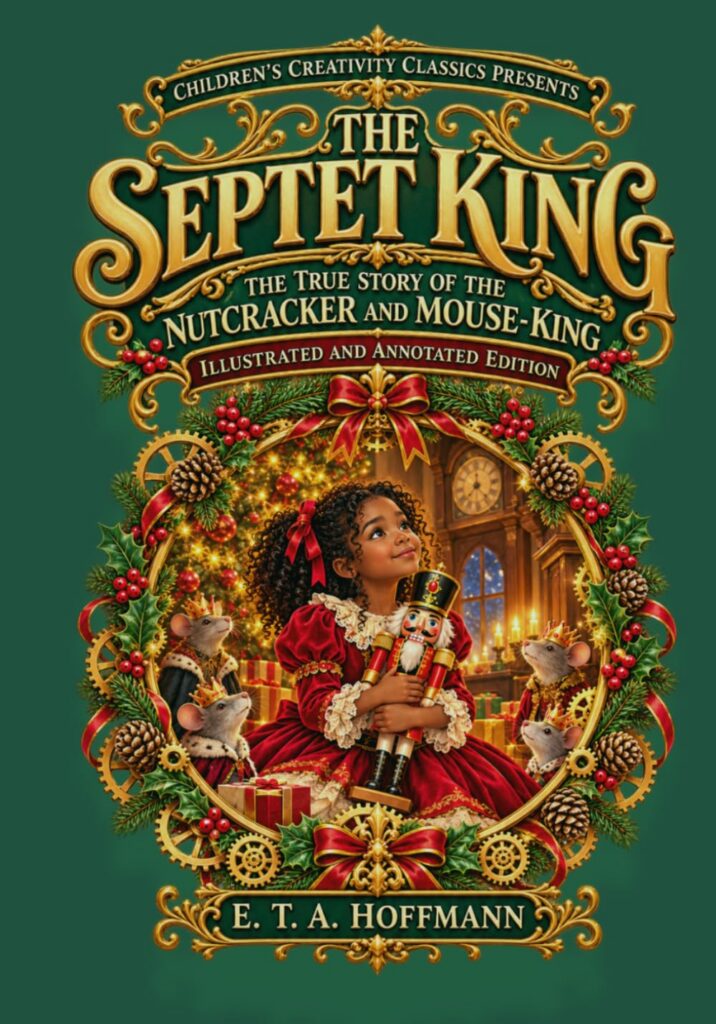
If you want a family tradition, read one chapter a night starting in early December. You can find the book here: The Septet King illustrated edition
What the original Nutcracker story still teaches us
The ballet gave us the music and the magic. The original Nutcracker story gives us a girl who saw something precious in an ordinary toy. Hoffmann wrote about looking past appearances, and about the courage it takes to be kind when nobody else is. Those lessons don’t pack away with the Christmas decorations. Read the original this year, and the Nutcracker you thought you knew may turn out to have a lot more to say.
Five facts about the original Nutcracker story
When was the original Nutcracker story published?
E. T. A. Hoffmann published The Nutcracker and Mouse-King in 1816, in a collection of children’s fairy tales called Kinder-Mährchen.
Which English translation does The Septet King use?
It uses Mrs. St. Simon’s translation, first published in New York in 1853. The edition keeps that historic text and adds notes and illustrations around it.
Did anyone retell the story before the ballet?
Yes. Alexandre Dumas published a retelling in 1844. That version helped inspire Tchaikovsky’s ballet, which premiered in Saint Petersburg in 1892.
How many heads does the Mouse King have?
Seven, and he wears seven crowns. The number seven shows up throughout the story, including in the instructions for breaking the magical nut Crackatuck.
When did E. T. A. Hoffmann die?
Hoffmann died in Berlin on June 25, 1822, at the age of 46, but his original Nutcracker story has outlived him by two centuries.