

Reading Aloud Tips for Parents Who Stumble Over Old-Fashioned Words
Quick Answer
The best reading aloud tips for parents who stumble are to preview the page, slow down, say a hard word your best guess and keep going, and let children see that mistakes are fine. Children listen for your attention far more than for polish.
Older stories, like Hoffmann’s Nutcracker, have long sentences and unfamiliar words. A few small habits turn them from a source of dread into a shared adventure.
Key Facts
- The American Academy of Pediatrics’ 2024 policy statement describes reading aloud as a chance to build loving, nurturing relationships, and suggests making books part of a bedtime routine.
- The statement favors print books with colorful pictures and rich language, and encourages responsive, back-and-forth reading.
- Hoffmann’s Nutcracker and Mouse King dates from 1816, so English editions are translations of a story more than two hundred years old.
- The story has fourteen chapters, which makes it easy to read in short sittings.
- Older English translations of the story are available free online, including on Wikisource, which makes it easy to practice a page before reading it aloud.
Why reading aloud tips for parents matter more with classics
Modern picture books are written to be read aloud. They have short lines, strong rhythms and words a four-year-old can follow. Older stories are different. They were often written to be read silently by adults, or read aloud in a different era, and their sentences can wander.
That is why so many parents who read confidently every night suddenly feel uncertain when they pick up a classic. A word you have never seen, a name you are not sure how to pronounce or a sentence that seems to have no end can leave you feeling exposed in front of your own children.
Here is the reassuring truth: this feeling is common, and it is manageable. The AAP’s 2024 statement describes shared reading as a way to build relationships, not as a test of delivery. What your child is absorbing is your presence, your voice and your interest. A stumble does not undo any of that, and a recovered stumble teaches something useful.
Before you read: five small preparations
Most of the stress of reading cold disappears with a few minutes of preparation. You do not need to rehearse the whole book.
- Skim tonight’s chapter. Five minutes is enough. You are looking for names, odd words and the shape of the scene.
- Mark the tricky words. A pencil dot in the margin, or a sticky note, tells you where to slow down.
- Decide how to say the names. If you are not sure, pick a pronunciation and use it consistently. Children care about consistency, not accuracy.
- Find the stopping point. Know where you will pause, even if you have to stop mid-chapter.
- Read the first sentence aloud once. Starting is often the hardest part. A practice run quiets the nerves.
If your edition is annotated, glance at the notes for the chapter. Notes that explain a word or custom beforehand can save you from pausing mid-sentence.
While you read: what to do when you trip
Everyone trips. What matters is what happens next. These habits work for most readers.
Slow down. When you hit a long sentence, take a breath and read it at half speed. Slower reading is easier to follow, and it makes mistakes less likely.
Break the sentence. If a sentence is too long, find the natural pauses and read it in pieces. Nobody will notice that you inserted a breath.
Guess and move on. If you do not know how to say a word, say your best version and keep going. If it is important, you can look it up later.
Laugh, briefly. If you mangle something, a small laugh and a “let me try again” show children that mistakes are ordinary. They learn from watching you recover.
Paraphrase when needed. If a sentence is too thick, summarize it in your own words and move on. A story told in your voice is still the story.
Invite help. Older children often love to be asked, “Do you know what that word means?” It turns your uncertainty into their moment.
A few older-language words, and what to do with them
You do not need a glossary to read a classic, but a general strategy helps. When you meet an old title, a formal phrase or an unfamiliar object, ask yourself three questions.
- Does the child need to know what this word means to follow the scene?
- If yes, can I explain it in one short sentence?
- If no, can I read past it?
Most of the time, the answer to the first question is no. A child can follow a story without knowing the exact meaning of every noun. When it matters, a one-line explanation, such as “That’s an old word for a kind of carriage,” is enough.
This is where a good annotated edition earns its place. Notes alongside the text let you say, “Oh, that’s what that means,” without leaving the book to search. They can also tell you when a passage is likely to be heavy, so you are not surprised. Whether a particular edition does this well is something to check in the sample pages, not to assume.
For the scary or sad pages
Stumbling is not the only fear. Many parents worry about reading a frightening or emotional passage in a shaky voice. Hoffmann’s original, for example, includes a seven-headed Mouse King, a night battle and a heroine who is hurt and not believed by her parents.
A few practical steps help:
- Read the heavy chapters earlier in the evening, when you and your child are less tired.
- Slow down and lower your voice, rather than speeding up.
- Pause to ask, “How are you feeling about this part?”
- Remind the child what you know from your preview: the hero is brave and things will turn out.
The AAP highlights responsive, back-and-forth reading. A check-in at a tense moment is a perfect example of it.
Ways to build confidence over time
Reading aloud is a skill that improves with repetition. If you want to feel more comfortable, try these gentle practices.
- Read a little every day. Even five minutes builds fluency, and the routine itself is a gift to children.
- Record yourself once. Listening to your own reading can be uncomfortable, but it shows you that you sound better than you think.
- Practice with a free text. Because older translations of Hoffmann’s story are free online, you can rehearse a page or two before committing to a printed edition.
- Share the job. Take turns with a partner, or invite an older child to read a paragraph.
- Keep a book you love close. Alternate between a challenging classic and an easy favorite, so reading stays enjoyable.
Is a special edition worth it for nervous readers?
If you are a nervous reader, an edition with help built in can lower the barrier. Illustrations give children something to look at when you pause. Notes give you a safety net. A well-made print book also feels like a promise that you will come back to it.
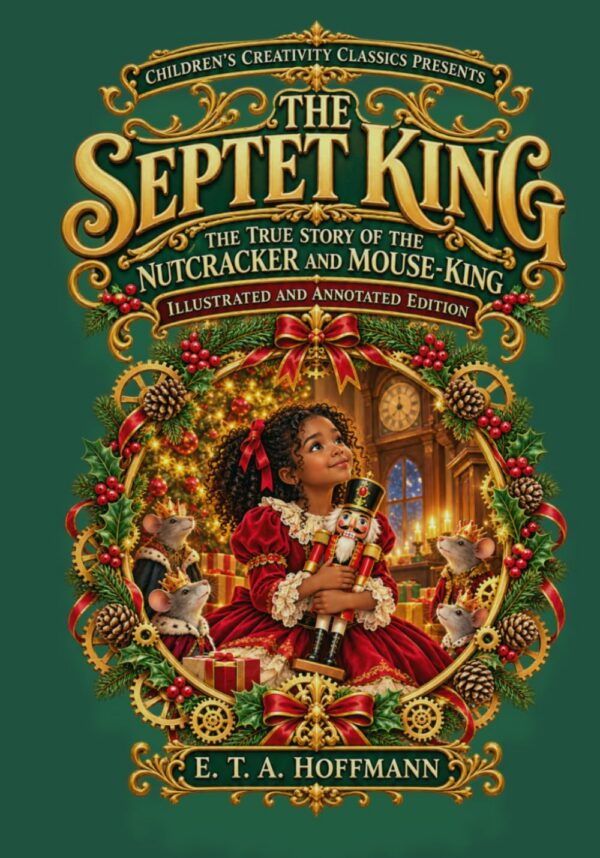
Whether that is worth the price depends on you. The Uply Media Publishing page lists The Septet King, an illustrated and annotated edition of the Nutcracker and Mouse-King story, at $22.98, reduced from $27.98, as of October 22, 2026. The page does not say what the annotations cover or how they are laid out, so use the sample pages to judge. If you would rather test the waters first, a free translation costs nothing.
Putting these reading aloud tips for parents to work tonight
You do not need to master all of these reading aloud tips for parents at once. Choose one. Maybe tonight it is the five-minute preview. Maybe it is the permission to guess and move on. Maybe it is simply the decision to laugh the next time you trip.
The children in your life will not remember whether you pronounced every name correctly. They will remember the lamp, the blanket and the sound of your voice trying. That is the thing worth repeating tomorrow.
An edition with a safety net built in
If you would like to look at an illustrated, annotated edition of the Nutcracker and Mouse-King story, see The Septet King on Uply Media Publishing.
Frequently Asked Questions
What should I do when I don’t know how to pronounce a word?
Say your best guess, use it consistently and keep going. Children care about the flow of the story more than about perfect pronunciation.
Is it okay to skip a word or a sentence?
Yes. If a passage is too thick, paraphrase it in your own words. A story told warmly is still the story.
How can I get better at reading aloud?
Read a little every day, preview each chapter and practice with a free text before you read a printed edition aloud.
Do I need to do voices?
No. Changing your speed and volume does most of the work. Voices are optional.
Does the AAP say anything about reading aloud?
Its 2024 statement recommends shared reading from birth through at least kindergarten, favors print books and highlights responsive reading and bedtime routines.
What if my child corrects my pronunciation?
Thank them and try again. It shows that reading is a shared activity and that everyone makes mistakes.